Wednesday, May 24, 2006

F For Fake


F For Fake (Orson Welles, 1976) [5]
This is a rambling, shabby documentary which was the last finished film released by Welles. I begrudgingly recommend it because it does what Welles says it’s going to do; play with the notion of what is real and what is fiction. What starts as a straight-forward doc on a notorious art forger morphs itself into a meditation on the nature of creating hoaxes and fiction, which is essentially what filmmaking is all about. What really intrigues me about the film is Welles’s domineering presence in the film. He overshadows the two characters that he meant to chronicle. This could have been extremely pretentious, but it comes across as engaging. The film itself has no center, as it ambles from thought to thought, with Welles giving just enough information to keep it together for the most part. The end goes off on an extreme tangent about Picasso and some women, but it makes sense when you realize the ground rules that Welles laid down at the start of the film (I won’t give away the secret). It’s not close to the best work of Orson Welles, but it certainly has its interesting moments.

On another note, occasionally, I will revise some of the grades of films that I've given. I felt I was a little too generous with a couple. Me and You and Everyone We Know went from 9 to 8 and 2046 is now a 9.

Munich


Munich (Steven Spielberg, 2005) [10]
With the exception of Schindler’s List, I haven’t been that big of a fan of Spielberg’s work. I respect that he has considerable skills in the craft of filmmaking, but I always find his films sterile and overblown. Munich is almost the exact opposite, a film that has tangible emotions but crafted in a way that makes it entertaining in typical Spielberg fashion. This is a film that has a moral ambiguity and doesn’t take a specific political side in the Israeli-Palestinian conflict but still creates empathy for the Israeli operatives. The one point where they are foiled by supposed CIA agents in an assassination attempt actually had me mad at the Americans. While this sympathy with the main characters could be a determent, I think it works in advantage for the film. The audience progresses as the characters do: at first gung-ho in their tasks, but as events progress, everything they’ve been doing gets questioned. I feel Spielberg is trying very hard not to take sides, and he is questioning the endless cycle of revenge and violence that has ensnared the debate. He does it tactfully, and even though the film is fairly simple in political terms, it’s still effective in the overall scheme. I was also really impressed with the filmmaking, as Spielberg adopts a more European, 1970’s visual style with all the handheld camera work and use of the zoom lens. Like Schindler’s List, Munich goes beyond the standard entertainment that Spielberg films usually give. When he does that, he makes films that I really like. The best film of 2005.

Monday, May 22, 2006

Monthy Listening Post - May 2006

This past weekend was my college graduation - sort of (I have one more class to take in the fall but Binghamton University let me walk in the ceremony) so I've been a little busy of late. I did see Munich over the weekend, and while never a big Spielberg fan, it's one of his best and on my top of 2005 list. A review will be posted in the next couple of days.

May's listening post is a little late this month. Since I'm heading to Bonnaroo next month and I don't think I'll have another listening post post until after I get back, this month is a collection of some of my favorite past performances that I've seen as well as some acts I'm going to catch this year:

1) Gomez - How We Operate
2) Bright Eyes - I'm Wide Awake, It's Morning
3) The Black Crowes - Live at Bonnaroo 2005
4) My Morning Jacket - Live at Bonnaroo 2004
5) Drive-By Truckers - Live at Bonnaroo 2005

Thursday, May 18, 2006

The New World


The New World (Terrence Malick, 2005) [8]
The films of Terrence Malick are the reason that I became a film buff. I saw The Thin Red Line and it was a eureka moment for me. Days of Heaven is one of my top three favorite films. From all this you might think I have a bias towards any new Malick film. I certainly like this a lot but I was a little disappointed in the film overall. The first thirty minutes are utterly fantastic, the visual majesty just stupendous. My issue comes with about the final third of the film, with John Smith gone, and John Rolfe in. I’m not saying Colin Farrell is a great actor but he has a presence that is much more in tune with the film than Christian Bale as Rolfe. It feels to me that this section removes itself too far away from the meditative presence of the natural world that was so predominant in the first half. It kind of redeems itself with a nice juxtaposition of imagery at the end of Pocahontas, but I still feel the strongest moments exist with her with Smith in the new world. All in all, I still admire the film just for the staggering beauty of the cinematography, which drew me into Malick’s films in the first place.

Monday, May 15, 2006

Milk Was a Bad Choice


Anchorman: The Legend of Ron Burgundy (Adam McKay, 2004) [5]
I’ve seen pieces of this but have never sat down and seen the entire film. That may work to its’ disadvantage, seeing that this is a film of funny moments that doesn’t quite make a very good film. The plot really isn’t that important, it’s just a way to let the jokes out. Will Ferrell’s performance has its really hilarious moments but at other times it feels he’s trying too hard to come with an out-of-left-field joke or response. It feels like a lot of this was improvised, which means a lot of it is hit and miss. Still, its funny moments are a lot better than most comedies being released today. And it has possibly the most absurd, hilarious line I’ve ever heard in a movie.

Fair and Balanced?


Outfoxed: Rupert Murdoch’s War on Journalism (Robert Greenwald, 2004) [4]
Here’s a big surprise for you: the Fox News network is in cahoots with the Republican Party and gets across an overwhelmingly conservative viewpoint! The problem with this film is the only people that are going to see it are ones that already know that Fox News is a joke of a news network. So Greenwald doesn’t have to do much except preach to the choir. It’s a shame that these hack, partisan documentaries (on both sides of the political spectrum) are getting so much notoriety because they plain stink as films. This film doesn’t have any filmic elements to it, just a lot of talking heads and the ironically at time, the same graphic schematic that Fox News utilizes so well to their advantage. It’s never good when you’re argument is relying solely on far left talking heads, the exception being a couple of scenes with Walter Cronkite. The film does have some good moments, most prominent being the Bill O’Reilly “Shut Up!” montage. As a liberal though, I can find nothing here that I didn’t already have a hunch about, which is a little disappointing.

Monday, May 08, 2006

The Essential Collection: The Long Goodbye


The essential collection are films that I have already seen and own that I consider some of my favorites . All of these films I have seen before and for the most part, they received a grade of 9 or 10 with some exceptions. As I re-watch these films, they will get a post under being part of the Essential Collection. The latest edition to the collection is The Long Goodbye, from 1973 by Robert Altman. I'm a little up and down when it comes to Altman films, but this is definitely my favorite of what I have seen of his work. What really appeals to me is that Altman has reinvented Philip Marlowe from the tough Humphrey Bogart character of 1940s L.A. and placed him in 1970s L.A., all frumpy and mumbling, played by Elliot Gould. It can be seen by some to be a disatrous move, but I think it was brilliant. The concept of "Rip Van Marlowe" is key here, as it seems as Marlowe had been asleep for thirty years only to wake in the 70s and be completely out of place. I really like Gould's portrayal of Marlowe, nothing like Bogart's, but something that still makes him sympathetic. The story is a typical winding Raymond Chandler plot with a lot of gaps not clearly filled in. Plot was never that important to Chandler and it's really not here, as the characters that inhabit the film really shine, especially Sterling Hayden and Henry Gibson. The Long Goodbye is often a forgotten film of Altman's, and while it's certainly of a certain time, there are plenty of things to like about it, especially Vilmos Zsigmond's cinematography.

Don't Look Back


Bob Dylan: Don’t Look Back (D.A. Pennebaker, 1967) [9]
Considering I’m a Dylan freak, I’m almost amazed at myself that it took me this long to see this film. There is no doubt that D.A. Pennebaker is one of the great rock and roll documentary filmmakers with this film and Monterey Pop, bringing the cinema verite style into these films. The most interesting thing about this film to me is that there really isn’t that much music, and when it is present, it’s underwhelming. Dylan is clearly bored with being considered a topical folk singer; he seems just to be going through the motions a lot. The one moment of premonition comes when the camera captures Dylan window shopping, gazing at some electric guitars. The real focus of the film is what occurs off the stage. From this film, one could get the impression that Dylan is a childish, crass b.s. artist. I think it shows an artist attempting to deal with all the inane questions from the press and all the ridiculous baggage of being “the voice of a generation.” The times they have-a changed, and Bob Dylan has changed, and this film is a perfect documentation of the young artist at a particular time in his career. This also has one of the most mean-spirited moments I have ever seen in a film. There's a scene where Donovan is playing a twee love ballad for Dylan, Dylan complements Donovan, takes the guitar from him, and goes into "It's All Over Now, Baby Blue." You can pratically see Donovan's soul getting crushed.

Friday, May 05, 2006

Some Food for Thought

Felt like posting some non-film related stuff. So here it goes:

1) Carlos Mencia is like that annoying kid in school who would say or do anything to get everybody's attention. He is quite possibly the most overrated (if he is held in any esteem at all) comedian today and his show is childish and simply put, sucks.

2) Josh Ritter's new album is possibly the best album I've heard since Ray LaMontagne's Trouble. If you don't know who he is or his sound, definitely check him out. (This reminds me of last Tuesday's Scrubs where J.D. describes himself as a "sensie", a sensitive guy whose soundtack is acoustic alternative. I think that pretty well describes myself. Josh Ritter fits into this category.)

3) This summer may be the best for concerts in a while. Since it's my last summer of reckless freedom before I have to go into the real world with a real job, I'm going to go to as many as possible. Besides my yearly trek to Bonnaroo, there's the Radio Woodstock Mountain Jam at Hunter Mtn. in upstate NY, there's the Black Crowes/Robert Randolph/Drive-By Truckers, Trey Anastasion & Mike Gordon with the Benevento/Russo Duo and Phil Lesh, Ray LaMontagne/Guster, Crosby, Stills, Nash & Young, and as every summer, the Allman Brothers. Then there's the great lineups at Lollapalooza and Austin City Limits, which I can't afford to go to.

4) The greatest 2 minutes in sports, The Kentucky Derby, is this weekend. I was lucky enough to go the 2001 Derby and have to say there is no sporting event quite like it. I have been around horse racing my entire life (my dad used to own a couple of horses), and while the culture of it may go against my leftist leanings, I still love it. I'll go with a Barbaro/Point Determined/Cause to Believe trifecta. If you have no idea what I'm talking about, just forget all of what I just said.

Monday, May 01, 2006

The Importance Of Being Earnest


The Importance of Being Earnest (Oliver Parker, 2002) [6]
I had to read Oscar Wilde’s play for a British Literature class, and subsequently we watched the latest film version in class. The problem inherent in making of a film of this play is that it isn’t a very long play, which means this film has some filler in order to get it to reach ninety minutes. I really don’t have much to say about this film. Wilde’s humor is consistently witty, and there are truly some really funny moments. But there is only so much I can take of lampooning upper class Victorian Britain; it’s not something that is that interesting to me. The material that was added to the film that wasn’t in the film doesn’t add anything else to the film and a couple of scenes added for comedy really don’t fit with Wilde’s humor. This film really isn’t supposed to be anything more than a filmed play, and director Parker is smart enough to stay within the boundaries that Wilde crafted. All in all, a breezy picture that no glaring faults that I can find.


By the way - I encourage anyone who is a rational thinking human being to support The Day Without Immigrant rallys and boycotts going on throughout the country today even though I'm being a total hypocrite and going to work. I still believe that all immigrants, illegal or not, deserve to have the same rights and opportunities as everyone else in this country.

Freak 'n' Roll Into the Fog


The Black Crowes: Freak ‘n’ Roll Into the Fog (director unknown, 2006) [7]
The problem with concert films in the age of digital media is that it has become possible that every band can make their own film for very cheap. While that may be good in that fans can have a keepsake of their favorite band, it has also made the quality of these films very poor. Concert films nowadays aren’t even close to the quality of a film like The Last Waltz or Woodstock. This one isn’t any different, but since The Black Crowes are one of my favorite bands, I’m going to like this. The fact is this is a better constructed film than some of the other direct to DVD concert films that I’ve seen. The continuity of shots and editing are much smoother than I really expected. The real reason I feel this is watchable is the performance of the band itself. I have seen The Crowes twice in the last year and they have never been better as a live act. The one thing this film does is capture a band at their pinnacle as a live act, and you can’t ask for much more than that.

Monday, April 24, 2006

The Ice Harvest


The Ice Harvest (Harold Ramis, 2005) [5]
This is a somewhat begrudging approval for a film that really had the potential to be a lot better. When this was released last holiday season, it was marketed as a black comedy a la Bad Santa. What this film actually is, however, is a modern noir laced with elements of black humor. I think that if Harold Ramis realized this, he could have made a much better film. John Cusack plays the standard noir protagonist, an everyday loser who gets into events way over his head. I liked Cusack’s character for the most part, but felt the film tried to hard at the end to make him a nice guy when he really did some awful things. I didn’t think there was enough humor to consider this a comedy even though Oliver Platt and Billy Bob Thornton do have some funny moments. The whole sequence between Thornton and the trunk are really great. The one real aspect of this film that I give issue to be that the beginning is a little rambling. It goes all over the place before it finally lands on the central action. The scenes where Cusack and Platt are together really seem too long and feel detached from the rest of the story. But I felt it picked itself up enough to recommend it, if just barely.

Tuesday, April 18, 2006

Brokeback Mountain


Brokeback Mountain (Ang Lee, 2005) [10]
Yes, I have finally seen this and after watching that piece of self-important garbage that is Crash take best picture over this, it makes me sick. Brokeback Mountain is by far the more superior film in every regard and in fact, much better than I anticipated. The film is essentially a melodrama with gay cowboys but I never said I didn’t care for melodrama. This is an achingly gorgeous film, in images as well as action. Ang Lee’s direction, while not taking many chances, is still enthralling, especially how he uses the images of the vast American frontier to frame this doomed love story. I don’t think I have seen a better first 45 minutes of an American film in quite a while. Lee simply lets the camera linger and let it capture. Nothing is forced in the acting, and the deliberate silence in which Ennis and Jack form their relationship is exceptional. Heath Ledger is great but there is something about Michelle Williams’ performance that really gets me. It almost borders on transcendence. That is the acting performance of 2005. A lot has been made of the politics of this film, but at its essence it is just a story about doomed love. That the relationship is a gay one has no consequence on the story itself, which is exquisitely told; the socio-political ramifications should have no bearing on its craft. As of right now, the best of 2005.

Monday, April 17, 2006

Monthly Listening Post - April 2006

The number of new releases this past couple of weeks has been tremendous. These are the best of what I've heard recently. I know I'm leaving the new stuff by Fiery Furnaces and Calexico, but I haven't got a chance to hear them yet.

1) Drive-By Truckers - A Blessing and a Curse (in my mind, this is the best band in the world right now)
2) Built to Spill - You In Reverse
3) The Flaming Lips - At War With the Mystics (a funny thing; when I first heart Yoshimi Battles the Pink Robots, I absolutely hated it. I listened to it a couple more times and saw them at Bonnaroo 2003 and now they're one of my favorites.)
4) Band of Horses - Everything All the Time (sounds like The Shins mixed with My Morning Jacket)
5) Josh Ritter - The Animal Years (may just be the album of the year)
6) Cory Branan - 12 Songs
7) Nicolai Dunger - Here's My Song...

Monday, April 10, 2006

The 40-Year-Old Virgin


The 40-Year-Old Virgin (Judd Apatow, 2005) [6]
Let me just say that you won’t find a bigger fan of Freaks & Geeks and Undeclared than myself. Those two shows were created and produced by Judd Apatow, who happens to direct this movie. So maybe I came into this with a little too high expectations. Its funny and all, but that’s about it. There’s nothing in this film that really creates the connection in me the way those two T.V. shows did. All that being said, it’s nice to see a comedy that can still be consistently funny and have some real emotion behind it. The characters, especially Steve Carrell’s, gets ridiculed but is still treated with humanity and real emotion. The character of Andy could have easily been a cheap joke punching bag, but he is portrayed as a real person. But I feel that Carrell does carry the film on his shoulders a little too much. I thought the other characters, while having tangible qualities, relied a little too heavily on stereotypical humor, especially the characters that weren’t white. I didn’t like the Paul Ruud character, and I’ve never found Paul Ruud really funny in anything. And I can’t remember a comedy that was over two hours long (unless you consider The Godfather, Part III…...ZING!).

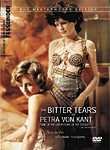
The Bitter Tear of Petra von Kant


The Bitter Tears of Petra von Kant (Rainer Werner Fassbinder, 1972) [8]
This is certainly the most obtuse and patient of all Fassbinder films I have seen to this point. That can be a good and a bad thing. I think that Fassbinder has hit the right notes in addressing how the women’s relationships are, especially between Petra and Karin. The film certainly does a good job of showing the manipulation and power inherent in these relationships which goes far beyond any homosexual context that’s on the surface. Even though I liked what the film was doing, I definitely had a hard time getting into it. I have to admit I fell asleep for a few short instances, but this was not out of boredom. It probably wasn’t a good idea to have a bottle of wine and then attempt to fully engage with this film. You need to have a lot of patience in order to really understand what Fassbinder is doing. That intense focus makes it difficult to give this a grade of greatness. That's not some simple, I-don't-want-to-think-while-watching-a-movie statement; I think that the film is a little too rigorous to fully enjoy.

Friday, April 07, 2006

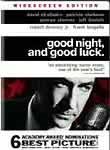
Good Night, and Good Luck


Good Night, and Good Luck (George Clooney, 2005) [7]
I was impressed enough with George Clooney’s direction, and thoroughly impressed with David Strathairn’s hard-bitten performance as Edward R. Murrow, but there wasn’t anything else in particular that overly impressed me with this film. The black-and-white cinematography is solid, with its fluidity in moving through the hustle and bustle of a newsroom and capturing the swirling cigarette smoke, which always looks cool in black and white. Clooney does a good job of laying out the situation for us, and Strathairn is great in his economy of action and expression. I just feel that there is some element in the story that is lacking that would make this a great film. I feel like there isn’t enough conflict and/or tension in the story between Murrow and McCarthy. Maybe it’s the fact that McCarthy only appears in archival footage, but it seems he and the actions of his heinous committee are too detached from the film. That’s a shame because I think this was one element away from being a really great film
.

Night and the City


Night and the City (Jules Dassin, 1950) [10]
It’s not very often that I have to run out and buy a film right after seeing but this one made me right out and do it. This is an incredibly entertaining film noir with a career-defining performance by Richard Widmark as an American grafter/club tout in London who is doomed from the start. Widmark’s performance as Harry Fabian, a naïve, believing he’s somebody when he ain’t dope is possibly one of the best I’ve ever seen (and I’m not exaggerating). While Widmark’s performance alone could carry the movie, Dassin’s direction isn’t too shabby either. The film is dropped into the messy London underworld, a place where nobody has a past and where only people with money have the power. The trouble starts when Harry beliefs he can become a big shot in the wrestling business only to have a series of unfortunate events occur that make his demise inevitable. There are some great film noir images here, with Dassin emphasizing the sweat, dirt, and worry on the character’s faces. An interesting fact: even though this is film noir, there is really no crime as the axis of the story. The film occupies a world of perpetual crime. I have to say that Night and the City is one of my favorite film noirs, and Jules Dassin, along with Jacques Toureur, as two of the most capable, yet forgotten noir directors.

Monday, April 03, 2006

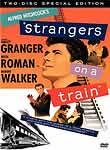
Strangers on a Train


Strangers on a Train (Alfred Hitchcock, 1951) [6]
I had just finished Patricia Highsmith’s novel of the same name that this film was based on for a class in crime fiction and wanted to see how the film stacks up. All being told it was a bit of a disappointment, mostly due to the drastic changes in story between the two. I don’t really think this is a bad film; Hitchcock was a master craftsman. It’s just that I thought the book was much better. What’s missing from the film that really bothers me is the depth of psychological darkness that Highsmith gives to the main characters. Hitchcock strips all that away so there can be a hero and a villain and the standard upbeat Hollywood ending. There are other minor details that get changed but nothing that irks me as much as what I think is a dumbing down of the Guy/Bruno relationship. I’ve been more respectful than a fan of Hitchcock’s work, and this film is tight enough of a suspense thriller that I have to give it a decent grade despite its faults.

Saturday, April 01, 2006

A History of Violence


A History of Violence (David Cronenberg, 2005) [9]
Definitely an interesting film and one that is really timely in certain aspects as a critique of American society. The discussion on violence really doesn’t interest me as much as the theme of the inability to be able to escape one’s past. That doesn’t mean I think the violent elements don’t work. They have a very visceral impact even though I think they almost border on being something out of a comic book. I know that’s Cronenberg’s style coming through and while it seems extreme, it fits in the notion that American culture has become readily accepting of violence as a part of life. The one aspect that really interests me is that Tom Stall is considered a hero for doing something that is pretty repugnant and extreme. Still after all this, I think the film really comes back to the idea that this man cannot escape the violence in his past, and that will always be a part of him. The uncertainty left at the end seems to fit because who knows where these characters, and the culture itself will end up.